Selling Candles: 15 Low-Cost Ways to Market Your Small Candle Business
This post links to our own products and may contain affiliate links. If you buy through them, we may earn a commission at no extra cost to you. Read our Affiliate Disclosure.
Your candles are tested, your labels are on, and you finally know what each jar costs you to make, so the next step is getting people to buy them. Selling candles comes down to getting your candles in front of the right people, earning their trust and making sure they remember where to find you.
Marketing a small candle business doesn’t require a big budget. Most of what works for small makers selling candles costs little or nothing beyond your time. It does take consistency, and a clear idea of which steps to take first.
That’s why the 15 ideas below are grouped into three stages: before your first sale, during your first 10 sales, and once you’re ready to grow. You don’t need all of them, so pick two or three from the stage you’re in, stick with them for a few months and build from there. If you haven’t settled on your prices yet, start with our guide on how to price candles, since every idea here works better when your margins are right.
Stage 1: Before Your First Sale
These five steps take a few hours before you start selling candles, and the ideas in the next two stages depend on them.
1. Know Exactly Who Your Candles Are For
It’s tempting to say your candles are for everyone, but “everyone” is hard to market to. Try to describe your ideal customer in one sentence: who they are and why they buy. For example, “busy parents who want a calm moment at the end of the day” or “people looking for a thoughtful host gift that doesn’t break the bank.”
That one sentence shapes everything else: the scents you lead with, the words on your labels, the photos you take and even where you sell. You’d photograph and describe a candle for a quiet self-care evening very differently from one meant as a housewarming gift.
Cost: Free. Time: About 30 minutes, once. First step: Write your one-sentence customer description and keep it where you’ll see it every time you create content.
2. Make Your Brand Look the Same Everywhere
When your labels, packaging, Etsy shop banner and Instagram posts share the same colors, fonts and photo style, people start to recognize your candles at a glance, even while scrolling quickly and often before they remember your shop’s name.
You can get there without a designer by choosing two or three main colors, one or two fonts and a simple label layout, then using them every time. If you haven’t settled on a name yet, start there: our guide to candle business names has more than 150 ideas grouped by style.
Cost: Low. Time: A few hours, once, plus small updates. First step: Write down your colors and fonts in a note so every new label, post or banner follows the same rules.
3. Take Product Photos That Sell (With Just Your Phone)
When you’re selling candles online, your photos do the job your hands would do at a market table. Shoppers can’t smell the candle, so the picture has to show the color of the wax, the size of the jar and the mood the scent is meant to create.
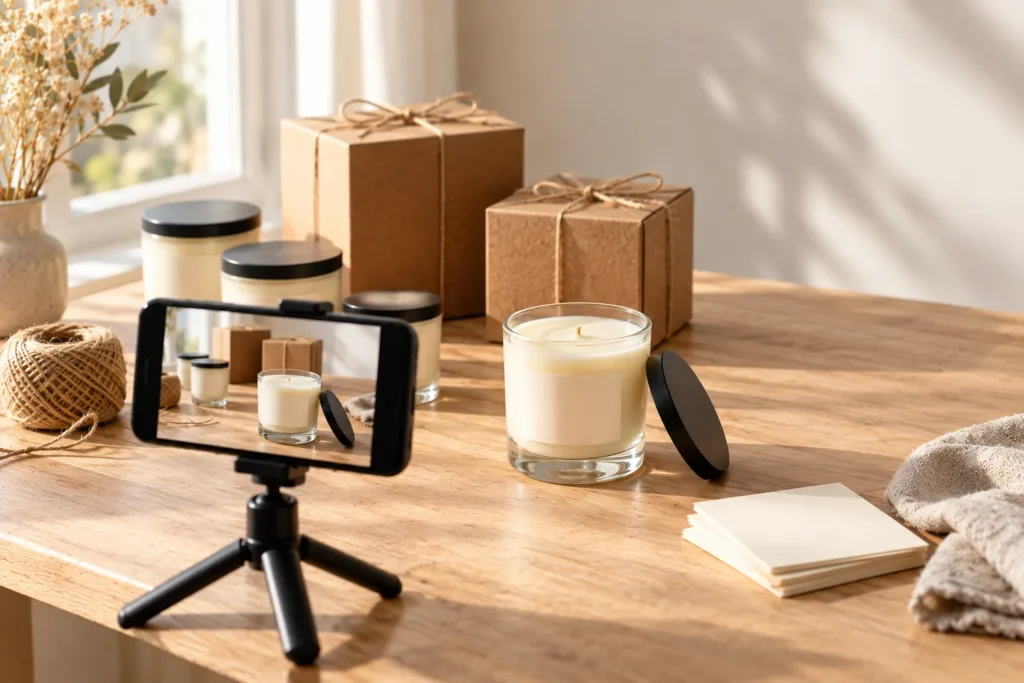
A recent phone camera is enough if you shoot near a window in soft daylight, keep the background simple and include at least one photo that shows the candle next to something familiar, like a hand or a book, so buyers understand its real size. Take a few lit shots too, since a glowing flame helps people picture the candle in their own home.
Lifestyle or stock images can work well for brand content on social media, but your product listings should always show your actual candles so buyers know exactly what they’ll receive.
Cost: Free. Time: 1 to 2 hours per new product. First step: Set up a small spot near a window and photograph one candle from the front, from above and in someone’s hand.
4. Set Up an Instagram Profile That Explains What You Sell
Many new customers will find you on Instagram before they ever visit your shop, and they decide in a few seconds whether to follow. Your profile has to answer three questions right away: what you make, who it’s for and where to buy it.
Say it plainly in your bio, for example: “Hand-poured soy candles for slow evenings at home. Shop the fall collection below.” Add your shop link and create a few Highlights for your collections, candle care tips and where to buy. Your grid should look like it comes from the same brand you defined in idea 2.
Cost: Free. Time: About 1 hour to set up. First step: Rewrite your bio so a stranger understands what you sell in one read.
5. Start Your Email List Before You Have Customers
Social media platforms change their rules all the time, and a post that reached hundreds of people last month might reach a handful today. Your email list is the one channel you fully own. When you launch a new scent or a holiday collection, an email lands directly in front of people who already asked to hear from you.
To start, open a free account with an email marketing tool, add a simple signup form to your shop or your link in bio, and give people a reason to join, such as early access to new scents or a small discount on their first order. Even a few dozen subscribers gives you a group of interested people to email on launch day.
Cost: Free to start. Time: 1 to 2 hours to set up. First step: Create a signup form and add the link to your Instagram bio.
Stage 2: Your First 10 Sales
When you’re just starting to sell candles, your first sales usually come from people who already know you, people who meet you in person and people who find you on marketplaces where buyers are already shopping.
6. Start With the People Who Already Know You
Friends, family, coworkers and neighbors are often a maker’s first customers, and there’s nothing awkward about that. Let them know you’ve started selling candles, share your shop link and invite them to buy if they like what they see.
At this stage, ask for honest feedback on the scent and the burn along with the sale, and ask whether they’d share a photo of the candle in their home. Those comments and photos become your first reviews and your first social proof.
Cost: Free. Time: A few hours over a couple of weeks. First step: Send a short message to 10 people you know with your shop link and a request for honest feedback.
7. Sell at Local Markets and Craft Fairs
Candles are something people want to smell before they buy, which makes in-person events one of the best ways to sell candles. Farmers markets, holiday fairs and pop-up events let customers pick up a jar, smell a tester and talk to the person who made it.
Bring a few uncovered testers so people can try your scents without opening every jar, and keep a QR code or a signup sheet on the table so visitors can join your email list even if they don’t buy that day. Booth fees vary a lot, so start with smaller local events and track what you sell at each one before committing to bigger fairs. Our Craft Fair & Market Day Planner can help you organize each event.
Cost: Booth fee plus display items. Time: Prep time plus the event day. First step: Look up two or three local markets for the coming season and check their vendor application dates.
8. Make Your Etsy Listings Easy to Find
Etsy is where many handmade candle buyers already shop, which is a big advantage when you’re new to selling candles, though you’ll be competing with thousands of other candle shops for attention. Write titles and tags with the words buyers type, like the scent, the wax, the jar style and the occasion, instead of creative names only you would search for. Etsy’s Seller Handbook also has free guides on getting your listings found.
Fill every photo slot, describe the scent notes and the jar size, and tell buyers roughly how long the candle burns. Complete listings answer questions before anyone asks them, which helps with both search and sales. Your own website, local shops and in-person events all work alongside Etsy, and we’ll cover the best places to sell candles in a separate guide.
Cost: Etsy’s listing and transaction fees. Time: 30 to 60 minutes per listing. First step: Rewrite the title of your best-selling listing so it starts with what the candle is and what it smells like.
9. Share Your Process in Short Videos
People love watching things being made, and candles are especially satisfying to film. A short video of wax being poured, a wick being centered or a lid going onto a finished jar can reach far more people than a still photo, especially on Instagram Reels and TikTok.
Prop your phone above your workspace, record a few steps of your next batch and add one line of text explaining what’s happening, with no need to talk on camera or spend hours editing. Behind-the-scenes clips show buyers the work that goes into each candle, which helps them see why handmade costs more.
Cost: Free. Time: About 1 hour per week. First step: Film your next pour from above and post it with one sentence about the scent you’re making.
10. Ask Every Buyer for a Review
Reviews are one of the main reasons a stranger decides to buy from a shop they’ve never heard of. Most happy customers are willing to leave one but forget, so make it easy for them. Add a small thank-you card to every order with a friendly request, and send a short follow-up message a week or two after delivery, once they’ve had time to burn the candle.
Good reviews also depend on the candle itself, since candles that burn evenly and smell as strong as promised earn better reviews. That’s why burn testing every new scent and jar combination is worth the time.
Cost: The cost of printed cards. Time: A few minutes per order. First step: Write a two-line review request and add it to your thank-you cards.
Stage 3: Growing Your Customer Base
Once you have steady sales and a few happy customers, these ideas help you reach new people and keep selling candles to the ones you already have.
11. Pin Your Candles on Pinterest
Pinterest works more like a search engine than a social network, because people go there to plan, whether it’s a cozy fall living room, a holiday gift list or a self-care routine, and candles fit naturally into all of it. A post on most social networks disappears from feeds in a day or two, while a good pin can keep sending visitors to your shop for months.
Create boards organized by scent, season or occasion, and pin your product photos with descriptions that include the words people search for, like “fall candle gift” or “vanilla soy candle.” Link each pin directly to the product page.
Cost: Free. Time: 1 to 2 hours per week. First step: Create a free Pinterest business account and set up three boards for your main collections.
12. Pitch Local Boutiques for Wholesale or Consignment
Local gift shops, boutiques and home decor stores often look for products their customers can’t find in big chain stores. Selling candles through a local shop puts your brand in front of shoppers you might never reach online.
With wholesale, the shop buys your candles up front, usually at around half of your retail price, and resells them. With consignment, the shop displays your candles and pays you a share only after they sell. Wholesale brings faster cash, while consignment is often easier to get started with. Either way, your prices need to leave room for the shop’s share, which our guide on how to price candles explains step by step.
Before you walk in, prepare a simple line sheet with your products, wholesale prices and minimum order. Our Wholesale Pricing & Line Sheet template can help you put it together. Most shops also expect a fire safety warning label on every jar, and the National Candle Association explains what that label should include.
Cost: Samples and printed materials. Time: A few hours to prepare. First step: Make a list of five local shops whose style matches your candles.
13. Partner With Local Businesses
Many local businesses share your ideal customers but don’t sell candles themselves. A florist could add a small candle to bouquet orders, a salon or spa could use your candles and sell them at the front desk, and a real estate agent might order candles as closing gifts for new homeowners.
Start with businesses you already know and like, and propose something simple, such as a small display, a co-branded gift set or a joint giveaway on social media. Local companies also buy gifts for clients and employees around the holidays, which can turn into larger orders.
Cost: Low, mostly samples. Time: A few hours to reach out. First step: Pick one local business you’d love to work with and bring them a sample in person.
14. Plan Seasonal Collections and Gift Sets
Candles are a popular gift, so the months leading up to the holidays are often the busiest time of year for selling candles. Planning a fall or winter collection ahead of time also gives you something new to talk about in your posts, emails and market booth.
Bundling two or three smaller candles, or pairing a candle with a matchbox or a wick trimmer, gives shoppers an easy gift option and raises the value of each order. Before you set a price, add up the full cost of every item in the set with our free Candle Cost Sheet, so a bundle never cuts into your profit.
Cost: Varies with materials. Time: Plan two to three months ahead. First step: Choose two or three scents for your next seasonal collection and set a launch date.
15. Gift Candles to Local Micro-Influencers
Smaller local accounts, such as a home decor page in your city or a lifestyle creator with a few thousand engaged followers, often have more trust with their audience than big accounts do, so you don’t need a celebrity to promote your candles.
Send a candle as a gift with a handwritten note, and don’t require a post in return. Many creators will share something they like anyway, and the ones who don’t may still remember you later. If someone does post, thank them, share their content and keep the relationship going. Creators who post about a free product should say it was a gift, and the FTC’s Disclosures 101 for Social Media Influencers guide explains how.
Cost: The candles plus shipping. Time: A few hours per month. First step: Find five local creators whose style fits your brand and follow their content for a few weeks before reaching out.
Where to Start: A Quick Comparison
If you’re not sure which ideas to try first, this table sums up all 15 by cost, time and the stage where each one helps most.
| Idea | Cost | Time | Best stage |
|---|---|---|---|
| 1. Know your ideal customer | Free | Once | Before your first sale |
| 2. Consistent branding | Low | Once, then small updates | Before your first sale |
| 3. Phone product photos | Free | Per new product | Before your first sale |
| 4. Clear Instagram profile | Free | Once | Before your first sale |
| 5. Email list | Free to start | Once, then ongoing | Before your first sale |
| 6. People who know you | Free | A few hours | First 10 sales |
| 7. Markets and craft fairs | Variable | Event days | First 10 sales |
| 8. Etsy listings | Low | Per listing | First 10 sales |
| 9. Process videos | Free | About 1 hour a week | First 10 sales |
| 10. Customer reviews | Low | Minutes per order | First 10 sales |
| 11. Pinterest | Free | 1 to 2 hours a week | Growing |
| 12. Wholesale and consignment | Low | A few hours to prepare | Growing |
| 13. Local partnerships | Low | A few hours | Growing |
| 14. Seasonal collections and gift sets | Variable | Plan months ahead | Growing |
| 15. Local micro-influencers | Low | A few hours a month | Growing |
Marketing Mistakes Small Candle Makers Make
Most of these mistakes come from good intentions when you start selling candles, like wanting to grow fast or reach everyone at once.
- Trying to be everywhere at once. Posting on five platforms leaves little time to do any of them well. Choose one social platform and one place to sell, then add more once those run smoothly.
- Photos with no consistent style. Mixed lighting, backgrounds and filters make a shop look unfinished, even when the candles are great.
- Not collecting emails. If you can’t reach a customer after their first order, you can’t tell them about your next collection.
- Giving up too soon. Most marketing takes a few months to show results. Give each idea at least 90 days before deciding whether it works.
- Competing only on price. Small makers can’t win a price war with big brands. Compete on scent, quality, your story and the way you treat customers.
Free guide + printable workbook
The Candle Business Starter Guide
Turn these ideas into a plan, from your first pour to your first sale. Inside the 37-page PDF:
- An 8-week action plan built around real cure and testing times
- 11 practical steps with clear checklists
- 11 fillable, printable worksheets, from a burn test log to a cost-per-candle sheet
Free. We’ll also send you practical tips for makers now and then. Unsubscribe anytime.
Frequently Asked Questions
How much should a small candle business spend on marketing?
There’s no fixed rule, and many small makers start with almost no budget. Most of the ideas in this guide cost time rather than money. Once sales become regular, set aside a small, fixed share of your monthly revenue for booth fees, samples and printed materials so you can plan ahead. Our breakdown of how much it costs to start a candle business shows where marketing fits next to your other expenses.
What is the best social media platform for selling candles?
Instagram is a natural fit because it’s visual and works well for short videos of your process. Pinterest is a strong second choice, since pins keep sending visitors for months. TikTok can reach new people quickly if you enjoy making videos. Pick the one you’ll keep posting on every week.
How do I get customers for my candle business?
Start with the people who already know you, then add one in-person channel, like a local market, and one online channel, like Etsy. Ask every early buyer for feedback and a review, and invite them to join your email list so you can reach them again when you launch new scents.
Can I sell candles without being on social media?
Yes, plenty of makers sell mainly through craft fairs, farmers markets, local boutiques and Etsy search. Social media helps people discover and remember you. If you skip it, put more energy into in-person events, wholesale and your email list.
How do I promote my candle business locally?
Local markets, partnerships with nearby businesses, wholesale or consignment with gift shops and gifts to local creators all cost little and put your candles in front of people nearby. Local community groups and events can also help people in your area find you.
Where can I sell my candles?
The most common places for selling candles are Etsy, your own website, farmers markets and craft fairs, and local boutiques through wholesale or consignment. Many small makers combine one online channel with one or two local ones.
Pick Two or Three Ideas and Start This Week
Selling candles gets easier once people can find you, recognize you and trust you. That doesn’t happen overnight, and you don’t need all 15 ideas to get there. Choose two or three from the stage you’re in, keep at them for about 90 days and pay attention to which ones bring in sales.
If you’re still in the early days, our guide on how to start a candle business and the free Candle Business Starter Guide walk you through the first steps. And if you want to check that your numbers work, see whether a candle business is profitable with real figures.