Starting a Candle Business: 11 Steps from First Pour to First Sale
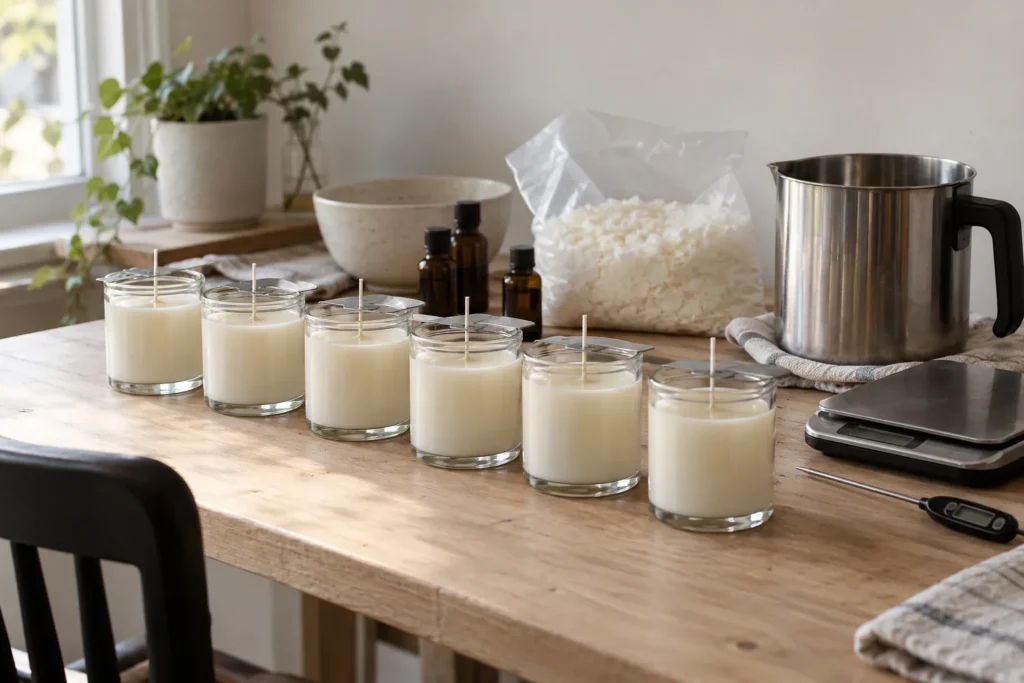
Pouring your first candle takes about an afternoon, while turning candles into a business takes a good deal longer, and most of that extra time goes into the parts nobody shows on social media: testing, pricing, labels, insurance and paperwork.
This guide walks through how to start a candle business in the order things tend to happen, from your first test batch to your first sale. We won’t promise quick money here. The goal is to help you build on solid ground, with candles that burn safely, prices that cover your costs and no surprises on the business side.
How to Start a Candle Business: The Short Version
- Learn the craft and test until your candles burn well.
- Start with a small, focused first line.
- Decide who you’re making candles for and why they’d choose yours.
- Know what it costs to get started.
- Price every candle from its real cost.
- Choose a name and set up the business basics.
- Check your safety warnings and your product and package labels.
- Look into insurance.
- Pick one place to sell first.
- Take good photos and write clear listings.
- Track everything and keep improving.
1. Learn the craft and test before you sell
A candle can look beautiful on the shelf and still burn badly once it’s lit, tunneling down the middle, giving off almost no scent, leaving soot on the glass or letting the jar get dangerously hot. Testing is the only way to find out, and it’s also the step new makers are most tempted to rush.
It helps to pick one wax and get to know it well before trying others. Many beginners start with a container soy wax such as 464, which is forgiving and easy to find. Keep in mind that soy candles need time to cure after pouring (suppliers generally recommend at least a week, and up to two weeks for the best scent throw), so every round of testing takes a while and is worth planning around.
For every test candle, write down:
- The recipe: wax, fragrance oil and percentage, wick size, jar and pour temperature.
- The cure time before the first burn.
- How it burns: whether the melt pool reaches the edges, how tall the flame gets, whether there’s smoke or soot, whether the wick mushrooms and how hot the jar becomes.
- How it smells when unlit (cold throw) and while burning (hot throw).
Burn your test candles the way a customer would, in sessions of a few hours, and keep going until you reach the bottom of the jar, because a wick that behaves well in the first hour can start acting up halfway down. Never leave a test candle burning unattended. Once a recipe burns cleanly from top to bottom several times in a row, you can consider it ready to sell.
We’ll go deeper into burn testing, choosing the right wick and how much fragrance oil to use in upcoming guides.
2. Start with a small, focused first line
Launching with ten scents in four sizes is tempting, but every combination needs its own testing, and even small changes like a different jar or a new fragrance can change which wick works.
You’ll usually get further by starting simpler, with one vessel size and three to five scents. That lets you test faster, buy supplies in larger quantities (which brings your cost per candle down) and learn what customers actually like before you expand. A second size or a seasonal scent can always come later.
3. Decide who you’re making candles for
Choosing that small first line gets much easier once you know who you want to serve. Picture one person and one buying occasion, whether that’s an affordable gift, a more refined fragrance for the home or a candle someone lights every evening, and let that guide your scents, vessel, packaging and price range.
Before buying more supplies, try to answer a few questions: who would buy this candle, how much do they usually spend, and where do they already shop? Looking at comparable products, their prices and their reviews will show you what buyers value and what still seems to be missing, and a few conversations with potential customers will tell you whether your assumptions hold up.
From there, try to sum up your positioning in a single sentence, such as “Candles for people looking for a housewarming gift, with soft scents and packaging that’s ready to give.” You don’t need to appeal to everyone. What matters is giving one specific group a clear reason to choose your candle, and making sure the price that group is willing to pay actually covers your costs.
4. Know what it costs to get started
You don’t need a studio to get going, since most makers start at the kitchen table with a small set of tools. The table below gives a rough idea of what a testing setup costs. Prices vary a lot by supplier and region, so treat these as ballpark ranges rather than quotes.
| Item | Rough cost |
|---|---|
| Soy wax, 10 lb | $30–$45 |
| Fragrance oils (4–5 sample bottles) | $25–$50 |
| Wick sample pack (2–3 sizes) | $10–$20 |
| Jars or tins (one dozen, one size) | $15–$35 |
| Pouring pitcher | $10–$25 |
| Thermometer | $10–$20 |
| Digital kitchen scale | $15–$30 |
| Wick stickers and centering tools | $8–$15 |
| Heat gun (optional, for smooth tops) | $15–$30 |
| Labels and warning stickers | $10–$25 |
| Total | About $150–$300 |
Beyond supplies, set some money aside for the business side: registering your business (fees depend on your state and structure), insurance and any marketplace setup fees. It’s also worth keeping every receipt from day one, since you’ll need them for your taxes and for pricing. A future guide on how much it costs to start a candle business will help you plan the full budget.
5. Price every candle from its real cost
Pricing is where many new candle businesses quietly lose money, usually because wax and fragrance are easy to count while wicks, jars, lids, labels, packaging, your time, test batches and marketplace fees are easy to forget, even though together they make up a real share of what each candle costs.
Before you list anything, work out what one candle really costs you and build your price on top of that number. Once everything is counted, an 8 oz soy candle can easily cost around $6 to make, which is why prices that look fine at first often leave almost nothing behind.
We walk through the full method, with a worked example, in How to Price Handmade Candles.
Want to work through this step on paper? The free Candle Business Starter Guide includes a Cost-per-Candle Worksheet, an 8-week plan and 10 more fillable worksheets.
6. Choose a name and set up the business basics
Your name will appear on every label, listing and invoice, so it’s worth settling on it before you register anything. A good candle business name is easy to say and spell, leaves room to grow (a name tied to one scent or one type of wax can box you in later) and is actually available. Before you commit, check that:
- Nobody is already using it for candles or home fragrance. The USPTO trademark database, Etsy and a regular web search are good places to look.
- The website domain and social media handles you want are free, or something close enough is.
- It still looks good at a small size, on a round jar label.
With the name chosen, the paperwork turns out to be less intimidating than it sounds, although the details depend on where you live. In the US, most small candle businesses work through some version of this list:
- Choose a structure. A sole proprietorship is usually the simplest option, but it doesn’t create an entity separate from you, so the business’s debts and liabilities can reach your personal assets. Registrations, licenses, a DBA and tax obligations still depend on your state and locality. An LLC can offer legal separation, though it doesn’t replace insurance or remove every form of personal liability. The SBA explains the differences between structures, and an accountant or attorney can help you choose.
- Check whether you need a DBA (“doing business as”) to operate under a name other than your legal one. Requirements vary by state, county and city, and registering a DBA neither creates an LLC nor gives you trademark protection.
- Check whether you need an EIN, the federal tax ID number. It’s required in situations such as hiring employees or operating certain business structures, while not every sole proprietor without employees needs one for federal tax purposes. When you do need one, you can apply for free through the IRS. Your bank may also ask for an EIN to open a business account, although it doesn’t replace any state licenses or registrations.
- Check licenses and permits with your state, city and county. Depending on your activity and address, you may need a business license or a home occupation permit, or have to follow zoning and fire-safety rules, and making candles at home doesn’t exempt you from checking. The SBA’s guide to licenses and permits and your local offices are good places to start.
- Understand your sales tax obligations before you sell. Etsy automatically calculates, collects and remits tax on orders shipped to states whose laws require marketplaces to do so, but that doesn’t necessarily cover all of your own registration and filing duties. For sales through your own website, at markets or through other channels, your obligations depend on your tax connection with each state (known as nexus), local rules and the sales you actually make. Check with the revenue department of every relevant state, including your own, rather than assuming nothing applies until you pass an online sales threshold. You can also read how Etsy handles US sales tax.
- Open a separate bank account for the business, however small it is, since it makes bookkeeping and tax time much easier.
Because rules vary from state to state and city to city, check your state’s business portal and your city or county office as well. This section is a general overview, not legal or tax advice. Treat the list as a starting point: our upcoming guide to candle business licenses and permits will go further, and the rules for your own address and sales channels always come first.
7. Check your safety and packaging labels
Labeling a candle involves two separate checks, and the first is fire-safety labeling. In the US, ASTM F2058 is a voluntary industry consensus standard for candle safety warnings, covering how those warnings are presented and how visible they are, so it isn’t a federal packaging law on its own. The CPSC lists the voluntary standards that apply to candles, and it’s worth reading the current edition of ASTM F2058 and confirming what your sales channels require.
The core warnings tell customers to keep the candle within sight, away from things that can catch fire and out of reach of children and pets. The example below is only an illustration and doesn’t replace checking the standard’s full requirements for wording, symbols, size and placement:
⚠ WARNING: Burn within sight. Keep away from things that catch fire. Keep away from children and pets.
The second check covers product and package labeling. The Fair Packaging and Labeling Act, which the FTC administers for the consumer products under its jurisdiction, together with state weights-and-measures rules, may require you to state the product’s identity, the name and address of the manufacturer, packer or distributor, and the net quantity. Both the FTC and NIST explain these requirements, so check how they apply to your packaging, including where the information goes and how large it needs to be. A typical candle label covers:
- The product identity and the name and address of the responsible business, as the applicable rules require. A brand name or a social media handle on its own may not be enough.
- The net quantity of contents in the required units, without the weight of the jar, lid or packaging. “Net Wt. 8 oz (227 g)” is one example, as long as that’s the actual amount of product.
- The scent name, as extra information that helps customers choose.
- Care instructions that match your own testing, such as trimming the wick before each use. These complement the safety warnings and don’t replace the required package information.
Review both sets of information before you print your labels. Because the topic deserves a closer look, we’ll cover candle label requirements in a dedicated guide.
8. Look into insurance
Even with careful testing and clear labels, a candle is still used with an open flame inside someone’s home. Product liability coverage can help if someone claims your product caused damage or injury, subject to the policy’s terms, limits and exclusions. It’s often part of a general liability policy, but make sure the policy explicitly covers making and selling candles.
Premiums vary widely with your location, sales volume, coverage limits, business size and claims history, so get several quotes before you start selling and compare coverage, deductibles and exclusions rather than price alone. When you talk to insurers, ask:
- Is product liability included, and does it specifically cover candles? Some policies exclude them.
- Does the coverage apply to sales at markets and events, not just online?
- How quickly can you get a certificate of insurance? Markets and local shops may ask for one.
Aim to have the right coverage in place before your first sale, whether it happens online or at a market. Our upcoming guide to candle business insurance will look at this step in more depth.
9. Pick one place to sell first
Every sales channel comes with its own costs, pace and skills, and starting with just one lets you learn it properly before adding the next.
| Channel | Good for | Keep in mind |
|---|---|---|
| Etsy | Built-in buyers already searching for handmade candles | Fees on every sale, lots of competition, shipping glass |
| Craft fairs and markets | Customers can smell before they buy, instant feedback | Booth fees, weekends, inventory to carry |
| Local shops | Steady orders once you’re in | Wholesale prices, consistent supply, insurance often required |
| Your own website | Full control, no marketplace fees | You bring all the traffic yourself |
If you choose Etsy, build its fees into your prices from the start. As of September 2026, Etsy charges a $0.20 listing fee and a 6.5% transaction fee on the item price plus shipping, and for sellers with a US bank account, Etsy Payments processing costs 3% plus $0.25. On an $18 candle with $5.50 shipping, those three fees add up to about $2.69, before sales tax or any other charges.
Processing also applies to any tax charged to the buyer. Orders attributed to Offsite Ads can add 15% or 12%, depending on your sales threshold and the program’s rules, and there may be a fee to open your shop as well. Check Etsy’s Fees & Payments Policy and Etsy Payments Policy before setting your prices.
Selling on Etsy and selling at craft fairs will each get a guide of their own, so you can prepare for whichever channel you choose.
10. Take good photos and write clear listings
Online shoppers can’t smell your candles, so your photos and words have to do that work for them. You don’t need expensive gear for this, since natural light from a window and a plain background go a long way.
- Show the candle clearly with a straight-on shot, one of it lit and one next to something familiar so buyers understand the size.
- Describe the scent in plain words, covering the top, middle and base notes and when you’d light it. “A cozy evening scent” tells a buyer more than a list of ingredients.
- Answer the practical questions about wax type, net weight, approximate burn time from your own tests and care instructions.
We’ll look at candle product photography in more detail in a later guide.
11. Track everything and keep improving
A simple notebook or spreadsheet is enough at the start, as long as you use it to keep track of:
- Batches: date, recipe and supplier lot, so you can trace any problem back to its source.
- Costs: every supply purchase, so your prices stay accurate when suppliers raise theirs.
- Sales: which scents and channels sell, and which don’t.
- Feedback: what customers say about the burn, the scent and the packaging.
After a few months, these notes will show you what to make more of, what to drop and when it’s time to raise your prices. Upcoming guides on batch tracking and on whether candle businesses are profitable will help you organize these records and make sense of your results.
What to expect in the first months
Setting honest expectations makes the early months of a candle making business much easier. Testing takes weeks before you sell a single candle, first sales often come in slowly, and many of them come from friends, family and people who meet you at local markets. Candles are also seasonal, with demand usually rising in the fall and around the holidays, so many makers plan their testing and stock around that.
None of this means it isn’t worth doing. It simply means the makers who last tend to be the ones who treat the first months as a time to learn, rather than as a test of whether they’ve “made it” yet.
Free guide + printable workbook
The Candle Business Starter Guide
Turn this guide into action, from your first pour to your first sale. Inside the 37-page PDF:
- An 8-week action plan built around real cure and testing times
- 11 practical steps with clear checklists
- 11 fillable, printable worksheets, from a burn test log to a cost-per-candle sheet
Free. We’ll also send you practical tips for makers now and then. Unsubscribe anytime.
Frequently asked questions
Do I need a license to run a candle business from home?
That depends on your activity, your state and your city or county. Check for a business license, home-based business rules and zoning, along with the sales tax registrations and duties that apply to your sales channels. It’s worth contacting your local offices before you start selling, because working from home or selling only on Etsy doesn’t automatically exempt you from these obligations.
Do I need insurance to sell candles?
It isn’t always required by law, but it’s strongly recommended, since candles are used with an open flame. Craft fairs and local shops may also ask for proof of insurance before they work with you.
How do I choose a name for my candle business?
Look for something easy to say and spell that won’t limit you as you grow, then check that it’s available as a trademark, a domain and a social media handle before you register it.
How long before I can sell my first candle?
With soy wax, plan on at least a few weeks. Each test candle needs one to two weeks to cure plus several hours of burn testing, and you’ll probably need a few rounds before you find the right wick for each scent.
How much does it cost to start a candle business?
A basic testing setup often costs around $150 to $300 in supplies, with registration, licenses and insurance on top of that, all of which vary by state.
Is a candle business profitable?
It can be, as long as your prices cover your full costs, including your time and fees. That’s why we suggest working out the real cost of each candle before you sell anything, and our guide on how to price handmade candles shows you how.
Should I start with soy or paraffin wax?
Both work well. Soy is popular with beginners and with buyers looking for natural materials, though it needs a longer cure, while paraffin and blends tend to release scent more easily. What matters most is choosing one and testing it thoroughly before adding another.
Starting a candle business mostly comes down to a series of small, careful steps: testing, understanding your customer, pricing, labeling, selling and learning as you go. Take them one at a time and you’ll build something that holds up. Use this guide as your starting point, and the more focused guides will help with each decision as you move forward.