
How to Price Handmade Candles (Without Guessing)
This post links to our own product and may contain affiliate links. If you buy through them, we may earn a commission at no extra cost to you. Read our Affiliate Disclosure.
Most candle makers price the same way. They look at what other shops charge, pick a number that feels safe, and hope it works out. The problem is that “safe” is usually too low.
Here’s what that looks like. A candle that sells for $12 looks like a healthy profit when the wax, fragrance, and jar cost $3.32. Count your time, your overhead, and Etsy’s fees, and that same candle leaves you about $4. Sell it to a shop at wholesale, and you’d barely break even.
This guide shows you how to price candles from real numbers, using a simple formula. You’ll see what goes into your cost, how to turn cost into retail and wholesale prices, and how to check that the price still works after platform fees. We’ll use one 8 oz soy candle as the example all the way through, and there’s a free spreadsheet at the end that does the math for your own candle.
How to price candles: the simple formula
Candle pricing comes down to three lines:
- Materials + Labor + Overhead = Cost
- Cost × 3 = Retail price
- Retail ÷ 2 = Wholesale price
Your retail price is what a customer pays. Your wholesale price is what a shop pays you when it buys candles to resell, usually about half of retail so it can double the price on its shelf. Even if you only sell direct today, make sure wholesale still covers your cost, so a boutique can stock your candles later without you losing money.
You may have seen the rule “cost × 2 for wholesale, then × 2 again for retail.” It works when your costs are very low, but for most small batches it pushes an 8 oz candle well above what customers actually pay. A 3x retail markup is a more practical starting point, and most makers land somewhere between 2.5x and 4x.
Now let’s fill in each part.
Step 1: Add up your materials per candle
Start with everything that goes into one finished candle. For each supply, divide what you paid by how many candles it makes:
Cost per candle = price paid ÷ number of candles it makes
For example, if a case of 24 jars with lids costs $36, each jar costs $36 ÷ 24 = $1.50. Do the same for wax and fragrance oil: weigh the wax and oil for one test candle, then work out how many candles a full case or bottle actually fills.
Here’s our 8 oz soy candle:
| Material | Cost per candle |
|---|---|
| Wax (6.5 oz) | $0.78 |
| Fragrance oil (0.52 oz, an 8% load) | $1.04 |
| Wick + wick sticker | $0.12 |
| Jar + lid | $1.50 |
| Front label + warning label | $0.25 |
| Tissue paper + insert card | $0.10 |
| Materials total | $3.79 |
Don’t forget the small things: warning labels, dust covers, and the candles you burn for testing. They’re easy to skip, and they add up.
Step 2: Pay yourself for your time
Your time is a real cost, even when you’re the only one in the workshop. To find labor per candle:
Labor = (minutes per candle ÷ 60) × your hourly rate
Time a full batch, from setup to cleanup, then divide by the number of candles. If a batch of 24 candles takes 2 hours to prep, pour, label, and clean up, that’s 120 minutes ÷ 24 = 5 minutes per candle.
At $20 an hour, 5 minutes of labor comes to $1.67 per candle.
For your hourly rate, use what you’d pay someone else to do the work. If labor isn’t in your price, the price only works as long as your time is free, and you’ll never be able to hire help.
Step 3: Add a share of your overhead
Overhead is everything you pay to run the business that isn’t tied to a single candle: electricity, tools that wear out, shipping supplies, website and app subscriptions, listing fees, product photos, and test burns.
Overhead per candle = monthly overhead ÷ candles made per month
If your overhead is $100 a month and you make 200 candles a month, that’s $0.50 per candle. When you’re just starting out and making fewer candles, this number will be higher. That’s normal, and it’s a good reason to track it.
Step 4: Turn your cost into retail and wholesale prices
Add the three parts together:
| Line | 8 oz soy candle |
|---|---|
| Materials | $3.79 |
| Labor | $1.67 |
| Overhead | $0.50 |
| Total cost | $5.96 |
| Retail (cost × 3, rounded up) | $18 |
| Wholesale (retail ÷ 2) | $9 |
At $18 retail, you keep the whole margin to pay for marketing, platform fees, and slow months. At $9 wholesale, you still make about $3 per candle ($9 − $5.96). If your wholesale price ever comes out below your cost, your markup is too low or your costs are too high.
Want to run these numbers for your own candle? Get the free Candle Cost Sheet.
Step 5: Check your price against the market
The formula gives you a starting point, not the final answer. Look up 5 to 10 listings like yours: same size, same wax, similar vessel. In a quick look at Etsy in September 2026, most single 8 oz soy candles were listed between about $14 and $20, with branded and premium candles going higher. Our $18 sits comfortably inside that range.
If your formula price lands well above similar listings, make sure your photos, packaging, and scent descriptions justify it. If the market really won’t pay it, fix the cost side instead of cutting your margin: buy supplies in bulk, switch to a less expensive vessel, or offer a smaller size at a lower price point. If it lands well below, you may be leaving money on the table.
Step 6: Check what you keep after Etsy fees
If you sell on Etsy, run one more check. For US sellers, standard fees are a $0.20 listing fee, a 6.5% transaction fee on the item price plus shipping, and a payment processing fee of 3% + $0.25. Here’s what that means for our candle (item price only, before shipping and tax):
| Line | Priced at $12 | Priced at $18 |
|---|---|---|
| Etsy fees | $1.59 | $2.16 |
| You receive | $10.41 | $15.84 |
| Profit after total cost ($5.96) | $4.45 | $9.88 |
At $12, you’re working for about $4 of profit per candle, and one broken jar or a free shipping promo eats most of it. At $18, there’s room to breathe.
Two things to watch. If you offer free shipping, the postage is now part of your price, and Etsy charges its transaction fee on shipping too. And if an order comes through Etsy’s Offsite Ads, there’s an extra fee of up to 15% of the order. Etsy updates its fees from time to time, so confirm your current rates in Shop Manager or on Etsy’s Fees & Payments Policy page.
Common candle pricing mistakes
Knowing how to price candles is half the job. Avoiding these mistakes is the other half.
- Pricing from materials only. In our example, materials are only about two-thirds of the real cost.
- Copying the cheapest shop. The lowest price in the search results may belong to a shop that hasn’t counted its labor or fees yet.
- Using a markup without checking the market. A formula that ignores what similar candles sell for can price you out of your category.
- Forgetting fees and shipping. Platform fees come out of every sale, and “free” shipping comes out of your price.
- Charging the same for every scent. Fragrance oils vary a lot in price. If a premium oil costs double, run the numbers for that scent separately.
- Setting prices once and never looking again. Recheck your prices whenever a supplier raises theirs, and at least twice a year.
Candle pricing FAQ
How much should I charge for an 8 oz candle?
It depends on your materials, your time, your overhead, and your market. Once you know how to price candles, the math for your own shop takes a few minutes. For our example, it comes to $18 retail, inside the $14 to $20 range where most 8 oz soy candles sat on Etsy in September 2026. Run the numbers for each size you sell.
Should my Etsy price and market price be the same?
Yes, keep your retail price consistent everywhere. Shops that stock your candles expect you not to undercut them online, and customers notice when prices don’t match.
What hourly rate should I use?
Start with what you’d pay a reliable helper in your area. You can raise it as your business grows, but don’t leave it at zero.
Get your free Candle Cost Sheet
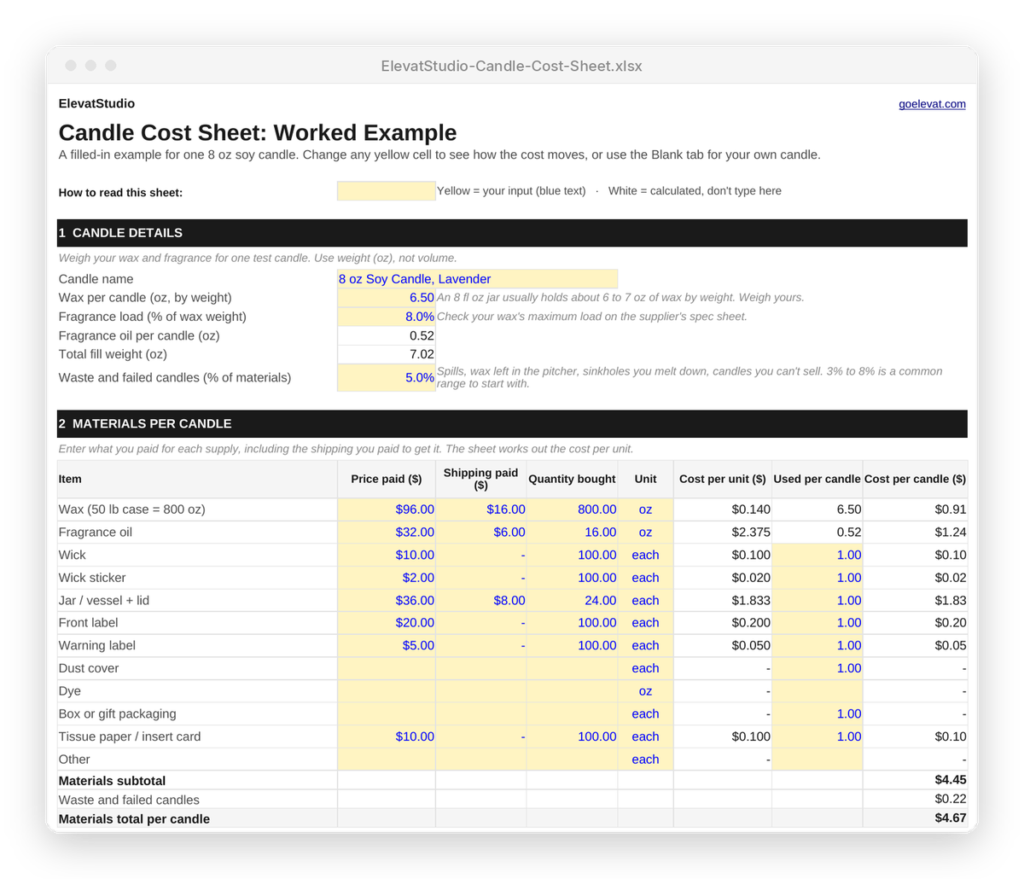
This post keeps the math simple. The free Candle Cost Sheet goes further: it works out your cost per unit from what you actually paid, adds the shipping on your supplies plus waste and failed candles, compares your price with similar listings, and checks it against Etsy fees. When we ran our 8 oz example through it, the real cost came to $6.84, not $5.96, and the suggested price moved from $18 to $21.
It has a worked example tab and a blank tab for your own candle, and it works in Excel and Google Sheets.
No spam. Unsubscribe anytime.
No spam. Unsubscribe anytime.
If you sell several sizes and scents and would rather not run these numbers by hand, we also make a Candle Cost & Pricing Calculator that handles every candle in one spreadsheet. The free Candle Cost Sheet above is all you need to get started.