How Much Does It Cost to Start a Candle Business? A Realistic 2026 Budget
This post links to our own product and may contain affiliate links. If you buy through them, we may earn a commission at no extra cost to you. Read our Affiliate Disclosure.
Ask a few candle makers what it cost them to get started and you’ll hear anything from a couple of hundred dollars to several thousand. Most of that gap comes from what each person counted. Someone who poured at the kitchen table with tools they already owned spent little on supplies, while someone who opened with an LLC, a craft fair booth and their own website spent much more before selling a single candle.
Below, we break the candle business start-up cost into parts, from the first test batch to the first sale. We checked prices at US candle suppliers and retailers in October 2026 and grouped them into three budgets, so you can see which one looks most like your plan. Prices change often, so treat every number here as a starting point for your own budget rather than a quote.
If you’re still deciding whether to start at all, our guide on how to start a candle business walks through every step in order.
Candle business start-up cost: the short answer
To reach your first sale, a lean candle business spends about $240 to $890 on tools, testing supplies, a first batch, labels, packaging and shop setup. Liability insurance adds $525 to $800 for the first year, which brings a lean first year to about $760 to $1,690. A standard setup with a few more tools, printed labels and a DBA comes to about $990 to $2,110 in its first year, and a fuller launch with an LLC, craft fair gear and your own website can reach $1,630 to $4,460.
Insurance is usually the largest single cost. Supplies for testing and a first batch of 24 to 48 candles stay under $360, so how you set up the business and where you sell matter more to your budget than which wax you choose.
Three realistic budgets
The table below adds up the start-up cost of a candle business for three kinds of launch. The first six lines add up to what you spend to get going. Insurance and other yearly costs come next, and the last line shows your total for the first year.
| Cost group | Lean | Standard | Fuller |
|---|---|---|---|
| Equipment | $47–$127 | $159–$266 | $159–$266 |
| Testing supplies | $57–$165 | $61–$173 | $64–$179 |
| First batch (24–48 candles) | $61–$164 | $66–$177 | $66–$177 |
| Labels and packaging | $60–$299 | $126–$263 | $126–$263 |
| Business registration and permits | $0–$100 | $7–$365 | $35–$765 |
| Selling setup | $16–$30 | $46–$60 | $290–$838 |
| To get started | $240–$890 | $460–$1,310 | $740–$2,490 |
| Insurance and other first-year costs | $525–$800 | $525–$800 | $891–$1,966 |
| First-year total | $760–$1,690 | $990–$2,110 | $1,630–$4,460 |
Each budget assumes a different setup:
- Lean: only the essentials. You use the scale, saucepan and spatula you already have, melt wax in a pouring pitcher on the stove, print labels at home, sell on Etsy as a sole proprietor and buy a yearly liability policy.
- Standard: adds an electric wax melter, a heat gun, a wick trimmer, lids, labels from an online print shop, gift boxes, care cards, a simple photo setup, a DBA and a local business license where one is required.
- Fuller: swaps the DBA for an LLC and adds candle dye, one craft fair with a tent, table and card reader, a domain and a basic online store.
The LLC’s yearly report, the domain and twelve months of the online store all fall in the Fuller first-year line, which is why it grows faster than the others. The sections below show what goes into each line, so you can build your own version from the items you need.
Planning your own budget? The free Candle Business Starter Guide includes a Cost-per-Candle Worksheet, an 8-week plan and 10 more fillable worksheets.
Equipment: $47 to $266
Most of the tools you need are one-time purchases, and a few are probably already in your kitchen. Once a tool touches wax, keep it for candle making only.
| Item | Price range | Notes |
|---|---|---|
| Digital kitchen scale | $13–$31 | Weighs to 0.1 oz or 1 g; you may already own one |
| Thermometer | $6–$19 | A glass thermometer is cheapest; digital or infrared costs more |
| Aluminum pouring pitcher | $10–$14 | Used inside a saucepan of water on the stove |
| Saucepan for the water bath | $0 | One you already own, kept for candle making |
| Wick centering bars (12) | $5–$9 | Hold wicks straight while the wax sets |
| Silicone spatula | About $3 | For stirring in fragrance |
| Kitchen fire extinguisher | About $26 | Rated for grease and flammable liquids |
| Heat-resistant glove and kraft paper | $6–$26 | Protect your hands and your work surface |
| Electric wax melter (optional) | $75–$102 | Replaces the pitcher and stovetop |
| Heat gun (optional) | About $28 | Smooths the tops of finished candles |
| Wick trimmer (optional) | About $9 | Also handy during burn tests |
The fire extinguisher is the one item we wouldn’t skip, even on the tightest budget. Wax gets very hot and fragrance oil is flammable, and a kitchen extinguisher costs less than a 10 lb bag of wax. An electric melter is the biggest optional purchase, and it makes larger batches easier once you know your recipes work.
Testing supplies: $57 to $179
Before you sell anything, you’ll pour, cure and burn test a few versions of each candle. These supplies cover a first round of testing for three to five scents in one jar size.
| Item | Price range | Notes |
|---|---|---|
| Container soy wax, 10 lb | $29–$32 | Enough for testing and some early batches |
| Fragrance oil samples | $3.50–$12 each | 1 oz to 4 oz bottles, one per scent |
| Wick sample pack | $8–$28 | Two or three sizes to test against each other |
| Wick stickers (100) | $5–$6 | Hold the wick to the bottom of the jar |
| 8 oz jars or tins (dozen) | $8–$10 | One size only while you test |
| Lids (dozen, optional) | About $4 | If your jars don’t come with them |
| Candle dye (optional) | $3–$7 | Only if you plan to color your candles |
Fragrance is where this budget moves most. Three 1 oz samples cost about $10 to $12, and some suppliers sell a five-scent sample pack for about the same. Moving up to 4 oz bottles for five scents brings fragrance to around $60. Expect to run two or three rounds before a recipe burns well from top to bottom, and our guide on how to burn test candles shows what each round involves.
Your first batch: $61 to $177
Once a recipe passes testing, you’ll need stock to sell. A first run of 24 to 48 candles in one size is enough for a small Etsy shop or a single market table. Buying wax and fragrance in larger sizes brings the cost of each candle down:
| Material | Bulk price | Cost per 8 oz candle |
|---|---|---|
| Soy wax | $98–$108 for a 45 lb case | $0.89–$0.98 |
| Fragrance oil | $28–$37 for a 15 or 16 oz bottle | $0.95–$1.50 |
| Wicks | $9–$15 for 100 | $0.09–$0.15 |
| 8 oz jars | $8–$10 for a case of 12 | $0.66–$0.81 |
| Lids (optional) | $29–$41 for 144 | $0.20–$0.28 |
That works out to roughly $2.60 to $3.70 in materials per candle before labels and packaging. Bigger orders lower the cost per candle, but they also tie up money in stock you haven’t sold yet. For a first batch, keep quantities small and reorder once you know which scents sell. Our guide on how to price handmade candles shows how to turn these numbers into a price.
Labels and packaging: $60 to $299
Every candle needs a label with its safety warning and product details, and anything you ship needs a box that keeps glass in one piece.
| Item | Price range | Notes |
|---|---|---|
| Safety warning labels (100) | $3.50–$4 | Unless the warning is printed on your main label |
| Printable label sheets | $11–$25 | For printing labels at home |
| Inkjet printer (optional) | About $120 | Only if you print at home and don’t have one |
| Labels from an online print shop | About $51 for 96 | Replaces home printing |
| Shipping boxes | $0.46–$2.40 each | Sized for one or two 8 oz jars |
| Bubble wrap | About $9 | Or kraft paper and dividers |
| Packing tape and shipping labels | About $25 | For online orders |
| Gift boxes (optional) | $0.70–$1.02 each | For a more finished presentation |
| Care cards (optional) | About $10 for 100 | Burning and safety tips for customers |
The printer and the shipping boxes account for most of that range. Without a printer, the lean budget for this group stays under $200. Before you print, check what your labels need to include. Our guide to starting a candle business covers the safety warning and the product details most labels carry.
Business registration and permits: $0 to $765
What you pay here depends on how you set up the business and where you live. Many makers start as sole proprietors and spend little or nothing, while an LLC in a high-fee state costs much more.
| Item | Price range | Notes |
|---|---|---|
| Separate business bank account | $0 | Many banks offer accounts with no monthly fee |
| Sales tax permit | $0–$100 | Free in most states |
| DBA (doing business as) | $7–$100 | If you sell under a name other than your own |
| Local business license or home occupation permit | $0–$165 | Many cities don’t require one; check yours |
| EIN from the IRS | $0 | Free when you apply directly with the IRS |
| LLC filing fee | $35–$500 | Depends on your state |
| LLC yearly report or tax | $0–$800 a year | Counted with first-year costs; California charges $800 |
An LLC isn’t required to start, and the right time to form one depends on your state, your sales and how much risk you’re taking on. An accountant or attorney can help you decide, and our guide to starting a candle business explains the main options. If you plan to register a DBA or LLC under a brand name, choose and check that name first, and our list of candle business names can help you find one.
Insurance: $525 to $800 a year
Insurance usually costs more than your testing supplies and first batch combined. The yearly policies we found that include product liability for candles ranged from about $525 to $800. Many insurers let you pay monthly, which spreads the cost across your first year.
If you only plan to sell at one or two events at first, some insurers offer single-event coverage starting around $50, which can cover you until you’re ready for a yearly policy. Whatever you choose, check that the policy names candles, since some general crafter policies exclude products used with an open flame, and ask whether markets and online sales are both covered.
Selling setup: $16 to $838
Opening an Etsy shop is the cheapest of these options. Markets and your own website cost more, and some of those costs repeat: a booth fee for every event, a domain every year and a store plan every month.
| Item | Price range | Notes |
|---|---|---|
| Etsy shop setup fee | About $15, one time | Charged to some new shops when they open |
| Etsy listing fee | $0.20 per listing | One listing per scent to start |
| Photo light box (optional) | About $30 | A window with good daylight also works |
| Craft fair booth | $75–$500 per event | Neighborhood market to a larger craft fair |
| 10×10 pop-up tent | About $99 | For outdoor markets |
| Table and table cover | $10–$119 | Less if you already own a folding table |
| Card reader | About $59 | Plus a fee on every card sale |
| Domain name | About $18 a year | Counted with first-year costs |
| Basic online store plan | About $29 a month | Shopify Basic or similar; counted with first-year costs |
Etsy also takes a share of every sale through its transaction and payment processing fees, which you can check on Etsy’s Fees & Payments Policy. Those fees come out of each sale rather than your start-up budget, and our pricing guide shows how to build them into your prices. Most marketing can start for free, and our guide to selling candles shows low-cost ways to find buyers once your shop is open.
Costs that are easy to forget
A few expenses rarely make it into a first budget:
- Shipping on your supplies. Wax and glass are heavy, so shipping can add a lot to small orders unless you reach a supplier’s free-shipping minimum.
- Test candles that don’t pass. Every failed round still uses wax, fragrance and jars.
- Scents you won’t use. Some samples won’t fit your line, and that’s a normal part of testing.
- Card fees at markets. Card readers take around 3% of every sale.
- Your time. Testing and curing take several weeks before your first sale, so count those hours when you set your prices.
Our free Candle Cost Sheet adds supply shipping, waste and failed candles to the cost of each candle, so these expenses show up in your prices as well as your budget.
How to start a candle business on a budget
Starting with less money mostly means putting off the costs that don’t affect safety or quality. These habits keep a first budget small:
- Start with one wax, one jar size and three to five scents, since every extra combination needs its own testing and its own stock.
- Buy fragrance in 1 oz samples until you know which scents your customers like.
- Use the scale, saucepan and spatula you already have, and wait on the electric melter, heat gun and dye.
- Print labels at home on blank sheets for your first batches, as long as they carry the required warning and product details.
- Sell at one local market first, covered by single-event insurance, before paying for a yearly policy and an online shop.
- Put your first sales back into the business. Restock the scents that sell and drop the ones that don’t.
Three things are worth paying for from the start: enough testing to know your candles burn safely, insurance before your first sale and a kitchen fire extinguisher, which at about $26 is one of the cheapest items in the whole budget.
Can you start a candle business with no money?
Not quite, but you can start with very little. The leanest version of the budget above begins at around $240 for tools, testing supplies, a small first batch, labels and packaging. Add insurance before your first sale: single-event coverage starts around $50, and a yearly policy around $525. After that, each round of sales can pay for the next, so you don’t have much money tied up at once.
Grants come up often in searches about starting a candle business, but grants for this kind of business are rare. The SBA states that it doesn’t provide grants for starting or expanding a business. Its grants go to nonprofits, research programs and organizations that support entrepreneurs. Local programs and pitch competitions do appear from time to time, and your local Small Business Development Center can help you look for them, but it’s safer to plan your budget without counting on one.
How long it takes to earn back your start-up costs
Your break-even point depends on how many candles you sell and where. In our guide on whether a candle business is profitable, an 8 oz soy candle sold on Etsy for $18 leaves about $374 a month at 50 candles and about $114 at 25, after materials, fees, your time and monthly costs, including insurance. At that pace, a lean start-up spend of $240 to $890 comes back in under three months at 50 candles a month, or in two to eight months at 25.
First sales are usually slower than these examples, and demand for candles tends to rise in the fall and around the holidays, so it helps to plan your first year around that season. The free profit simulator in that guide lets you enter your own budget, price and sales to see where you’d land.
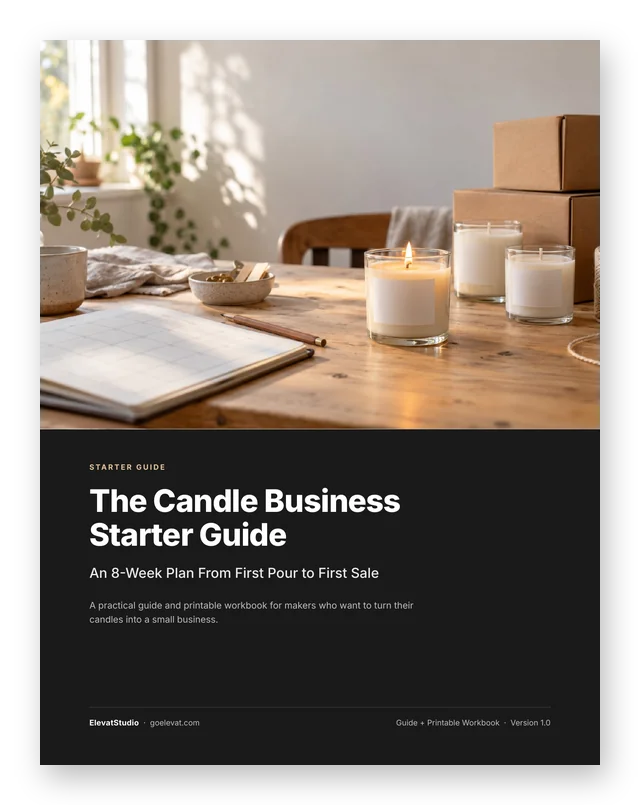
Free guide + printable workbook
The Candle Business Starter Guide
Turn your budget into a plan, from your first pour to your first sale. Inside the 37-page PDF:
- An 8-week action plan built around real cure and testing times
- 11 practical steps with clear checklists
- 11 fillable, printable worksheets, from a burn test log to a cost-per-candle sheet
Free. We’ll also send you practical tips for makers now and then. Unsubscribe anytime.
Frequently asked questions
How much does it cost to start a candle business?
A lean candle business usually spends about $240 to $890 to reach its first sale, plus $525 to $800 a year for liability insurance. With insurance included, a lean first year comes to about $760 to $1,690, a standard setup to about $990 to $2,110 and a fuller launch with an LLC and craft fair gear to as much as $4,460.
What’s the cheapest way to start a candle business?
Start with one wax, one jar size and a few scents, use tools you already own and print labels at home. Sell at a local market before opening an online shop, with single-event insurance covering that first market until you’re ready for a yearly policy.
Can I start a candle business with no money?
You’ll need at least $240 for tools, testing supplies and a first batch, plus insurance before your first sale. After that, you can grow slowly by putting each round of sales back into supplies.
Are there grants for starting a candle business?
They’re rare. The SBA doesn’t provide grants for starting or expanding a business, so plan to fund your start yourself. Local programs and competitions sometimes help, and a Small Business Development Center can point you to them.
Do I need an LLC to start a candle business?
No. Many makers start as sole proprietors and form an LLC later. State filing fees run from about $35 to $500, and some states charge a yearly fee as well, so it’s worth asking an accountant or attorney when an LLC makes sense for you.
How much should I spend on my first batch of candles?
A first batch of 24 to 48 candles in one size usually costs about $60 to $180 in wax, fragrance, wicks and jars when you buy in larger quantities, plus labels and packaging. Keeping it small lets you learn which scents sell before you buy more.
Why is insurance such a big part of the budget?
Candles are used with an open flame in people’s homes, so product liability coverage costs more than most supplies. The yearly policies we found that include candles ran $525 to $800, and markets and shops often ask for proof of insurance before you can sell there.
Supplies are the smaller part of a candle business start-up cost, and insurance is usually the larger one. Write your own budget line by line, begin with the lean version if money is tight, and use your first sales to decide where to spend next.
If you already sell several sizes and scents, our Candle Cost & Pricing Calculator works out the cost, price and profit of every candle in one spreadsheet.