How to Start a Soap Business from Home: 11 Steps to Your First Sale
When friends start asking for another bar, or a coworker offers to pay for the one you gave her, it’s natural to wonder whether your soap could become a small business. By then, the soap is usually the easy part. Selling it brings a different set of questions: how long each batch has to cure, what you’re allowed to say about it, what goes on the label, how to price a bar so it pays you back and whether you need insurance before your first market.
This guide walks through how to start a soap business from home in the order things tend to happen, from your first test batch to your first sale. We won’t promise quick money here. The goal is to help you sell soap that’s ready, at prices that cover your costs, with the rules understood before a customer or a market asks about them.
How to Start a Soap Business: The Short Version
- Choose one soap method and test it until your bars are consistent.
- Start with a small, focused first line.
- Decide who you’re making soap for.
- Know what it costs to get started.
- Price every bar from its real cost.
- Choose a name and set up the business basics.
- Decide whether each product is soap, a cosmetic or a drug.
- Label your soap correctly.
- Look into insurance.
- Pick one place to sell first.
- Track batches, cure dates and sales.
1. Choose one soap method and master it before you sell
Most home soap makers work with one of three methods. Each one changes your timeline, your safety setup and even what can go on your label, so it helps to pick one and get to know it well before you sell.
- Cold process: you mix oils with a lye solution, pour the batter into a mold and cut it into bars a day or two later. Most bars then need about four to six weeks to cure before they’re ready to use and sell.
- Hot process: the same ingredients, but you cook the batter so the reaction finishes in the pot. You still handle lye, and the bars usually have a more rustic look.
- Melt and pour: you melt a ready-made base, add scent and color, and pour. There’s no lye to handle and no long cure, but the base costs more per bar, and its ingredients count when you decide what kind of product you’re selling in step 7.
Whichever method you choose, safety comes before the business. Sodium hydroxide can cause serious burns, so wear safety goggles and chemical-resistant gloves, work with good airflow, keep children and pets out of the room and always add the lye to the water, never the other way around. Bramble Berry’s lye safety guide covers the full routine.
Run every cold or hot process recipe through a lye calculator before you make it, even when the recipe comes from a book or a trusted friend, because any change in your oils changes how much lye the batch needs. We don’t share recipes on this blog, since established suppliers and experienced soap makers already teach that part well. For every batch, write down:
- The recipe: oils and amounts, lye, liquid, fragrance and the superfat you set in the calculator.
- The batch details: the date, a batch code and the supplier lot of each ingredient.
- The cure: the date the batch should be ready and how one reference bar’s weight changes from week to week.
- How it performs: hardness, lather, scent after the cure and how the bar holds up in a soap dish.
Use-test your cured bars for a couple of weeks and give a few to friends who’ll tell you the truth. When you run a soap making business, consistency matters as much as quality, because the bar a customer buys in March should match the one she loved in January. Once a recipe gives you that result batch after batch, you can consider it ready to sell. An upcoming guide will cover how long to cure soap before selling.
2. Start with a small, focused first line
Launching with ten scents in three sizes is tempting, but every recipe and every fragrance behaves a little differently in the pot. Some fragrances thicken the batter quickly or change its color, and each change you make means another full cure before you can judge the result.
You’ll usually get further with one bar size and three to five variations, for example one unscented, one fresh and one warm. That lets you test properly, buy oils in larger quantities, which brings your cost per bar down, and learn what customers reach for before you add more. Hold off on special ingredients and on words like “moisturizing” until you’ve read step 7, because both can change how your soap is regulated.
3. Decide who you’re making soap for
Choosing that first line gets easier once you know who it’s for. Picture one person and one buying occasion, such as a gift, an everyday bar for the family or a small treat for the bathroom, and let that guide your variations, wrapping and price range.
Before you buy more supplies, look at 10 to 15 comparable soaps and note their price, weight, packaging and what reviews praise or complain about. Then talk to a few people who fit your customer and ask what they buy now and why. Goat milk and tallow bars are common niches and can be a good fit for some customers, as long as your descriptions stick to what’s in the bar instead of what it does for skin.
From there, try to sum up your positioning in one sentence, such as “Everyday bars for families who like to buy local, with mild scents and plain paper wrapping.” You don’t need to appeal to everyone. Aim to give one specific group a clear reason to choose your bar, at a price that group is willing to pay and that covers your costs.
4. Know what it costs to get started
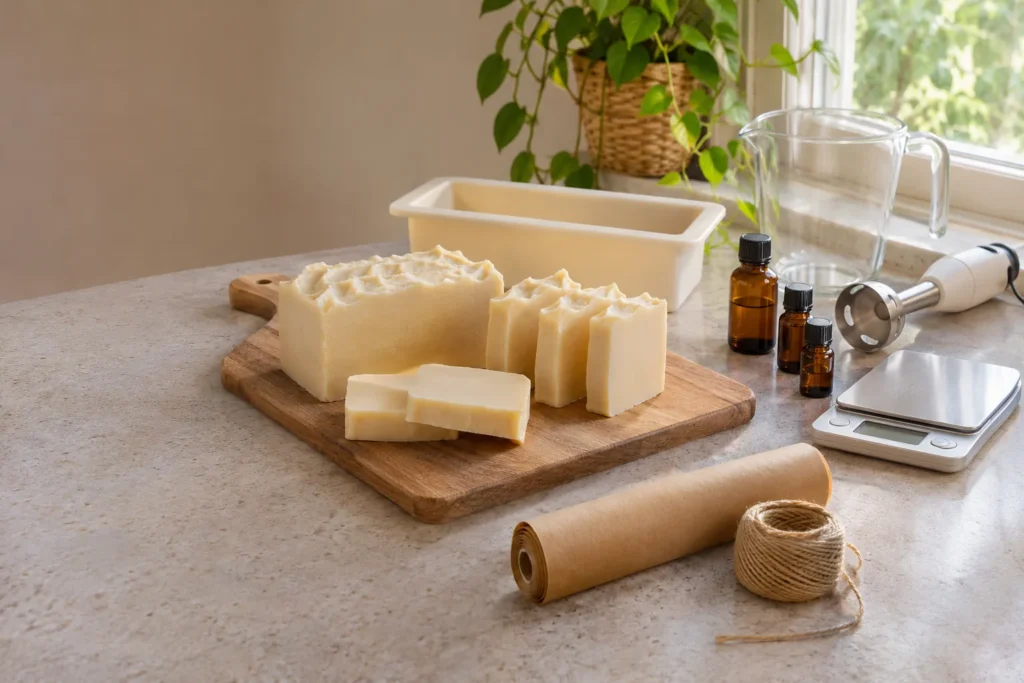
Most people starting a soap business begin in their own kitchen with a small set of tools. The table below gives a rough idea of what a cold process testing setup costs. Prices vary by supplier and region, so treat these as ballpark ranges rather than quotes.
| Item | Rough cost |
|---|---|
| Oils and butters for a few test batches | $30–$60 |
| Lye (sodium hydroxide) | $15–$20 |
| Fragrance or essential oil samples (3 to 5) | $20–$45 |
| Silicone loaf mold | $15–$30 |
| Digital scale | $15–$30 |
| Stick blender | $20–$35 |
| Safety goggles and chemical-resistant gloves | $15–$25 |
| Heat-safe containers, spatulas and thermometer | $15–$30 |
| Wrapping and labels | $10–$25 |
| Total | About $150–$300 |
If you want to start with very little money, melt and pour is the cheapest way in, because you skip the lye and the long cure, although the base costs more per bar once you’re selling. With cold process, one small batch made with the basic tools above lets you test the market before you buy oils in bulk.
Beyond supplies, set some money aside for the business side: registration (fees depend on your state and structure), insurance and any marketplace setup fees. Keep every receipt from day one, since you’ll need them for your taxes and for pricing. An upcoming guide to soap making supplies and startup costs will break down the full budget.
5. Price every bar from its real cost
Pricing is where many new soap businesses quietly lose money, usually because oils and lye are easy to count while fragrance, colorants, wrapping, labels, the bars lost to trimming and testing, your time and platform fees are easy to forget. On a small, low-priced product, those extras decide whether you make money.
Before you list anything, work out the cost of one sellable bar. Add up everything a batch costs, divide it by the bars you can actually sell after trimming and testing, then add your time and a share of overhead. Build your retail price on top of that number and check that it still fits the range you found in step 3.
Is soap making profitable?
It can be, and the margin depends on two things you control: the price you charge and how many bars you sell. Say a bar costs you $2.40 to make, all-in. Sell it for $8 and you keep $5.60 before fees, a 70% gross margin. Sell it for $5 and you keep $2.60, so you’d need more than twice as many sales to earn the same amount. That’s why the cost calculation comes before the price tag, and why it’s worth redoing whenever supplier prices change. An upcoming guide on how much to sell homemade soap for will include a free calculator.
Want to work through this step on paper? The free Soap Business Starter Guide includes a Cost-per-Bar Worksheet, an 8-week plan and 10 more fillable worksheets.
6. Choose a name and set up the business basics
Can you make and sell soap from home? In most places, yes, as long as you follow the rules where you live, and the paperwork is less intimidating than it sounds. Start with your name, since it will appear on every label, listing and invoice. A good soap business name is easy to say and spell, leaves room to grow and isn’t already taken, so check the USPTO trademark database, Etsy, a regular web search, the domain and the social media handles you want before you commit.
With the name chosen, most small soap businesses in the US work through some version of this list:
- Choose a structure. A sole proprietorship is usually the simplest option, but it doesn’t separate the business from you, so its debts and liabilities can reach your personal assets. An LLC can offer some legal separation, though it doesn’t replace insurance. The SBA explains the differences between structures, and an accountant or attorney can help you choose.
- Check whether you need a DBA (“doing business as”) to sell under a name other than your legal one. Requirements vary by state, county and city.
- Check whether you need an EIN, the federal tax ID number. Not every sole proprietor without employees needs one, and when you do, it’s free from the IRS.
- Check licenses and permits with your state, city and county, including a home occupation permit or zoning rules for working from home. The SBA’s guide to licenses and permits is a good place to start.
- Understand your sales tax obligations before you sell. Etsy collects and remits sales tax on orders shipped to states that require marketplaces to do so, as it explains in how US sales tax applies to Etsy orders. Sales at markets or through your own website are a different matter, so check with your state’s revenue department.
- Open a separate bank account for the business, however small it is.
In the US, if your net earnings from self-employment are $400 or more in a year, you generally have to file a tax return and pay self-employment tax, as the IRS explains. Because rules vary by state and city, use this list as a general starting point. It isn’t legal or tax advice. Upcoming guides will cover soap business names and whether you need a license or insurance to sell soap.
7. Decide whether your product is soap, a cosmetic or a drug
In the US, the same bar can fall under different rules depending on what it’s made of and what you say about it, and this decision shapes your label, your listings and sometimes your recipe. The FDA’s frequently asked questions on soap set out three conditions for what it calls true soap:
- It’s made mostly of fats or oils combined with an alkali such as lye.
- That soap does all of the cleaning, with no synthetic detergents.
- You label and sell it only as soap.
A product that meets all three is regulated by the Consumer Product Safety Commission. The CPSC’s soap business guidance covers its side and notes that ingredients commonly recognized as cosmetic can make a product a cosmetic even when you make no claims about them.
What you say about a bar can change its category as well. A bar you describe as moisturizing, deodorizing or making the user smell nice becomes a cosmetic, which the FDA regulates, and one you say treats acne or eczema, or kills germs, becomes a drug, with much stricter rules. The difference can come down to a few words:
- “Lavender soap made with olive oil” describes the bar.
- “Moisturizing lavender soap” makes a cosmetic claim.
- “Lavender soap that soothes eczema” makes a drug claim.
Those words count wherever you use them, on the label, in your Etsy listings, on social media and on the sign at your market table, because the FDA looks at how a product is marketed as well as how it’s labeled.
Selling a cosmetic is allowed and comes with its own requirements. The FDA doesn’t approve cosmetics before they go on sale, except for color additives, but you’re still responsible for their safety and for keeping records that support it. The Modernization of Cosmetics Regulation Act of 2022 (MoCRA) added federal requirements for cosmetics and exempts certain small businesses from some of them, such as facility registration and product listing. The FDA’s fact sheet for small businesses and homemade cosmetics is the place to check what applies to you. We’ll look at soap, cosmetic and drug claims in more depth in a dedicated guide.
8. Label your soap correctly
What goes on your label depends on the category you chose in step 7. Every bar needs the basics that tell customers what it is, how much of it they’re getting and who made it. Under the Fair Packaging and Labeling Act and your state’s weights and measures rules, that usually means:
- The product identity, such as “bar soap.”
- The net quantity, in ounces and grams.
- The name and place of business of the maker, packer or distributor.
Bars keep losing water as they cure, so set the label weight after the cure. Pick one reference bar per batch, weigh it every week until the number stops dropping and leave a small margin, so the label stays accurate while the bar waits on a shelf.
If your product is a cosmetic, the label also needs an ingredient list. The FDA’s page on cosmetic ingredient names explains that ingredients are listed by their common or usual names, generally in descending order of predominance, on a panel shoppers can easily see. For cosmetics, the FDA also says a post office box or a website address isn’t enough for the name and place of business. A simple label for a true soap might read:
Unscented Olive Oil Bar Soap · Net Wt. 4 oz (113 g) · Made by [Your Business Name], [Street Address], [City, State ZIP]
That example is only an illustration, so check the full requirements for wording, type size and placement before you print. Also keep in mind that soap made mainly for children 12 and under counts as a children’s product for the CPSC, which means third-party lead testing, a permanent tracking label and a Children’s Product Certificate. If you’d rather not take that on yet, keep children’s themes out of your first line. A dedicated guide to soap labeling requirements is on the way.
9. Look into insurance
Soap goes on skin every day, and people can react to an ingredient or fragrance in ways you can’t predict. Product liability coverage can help if someone claims your soap caused injury or damage, subject to the policy’s terms, limits and exclusions, and markets and shops may ask for proof of insurance before they agree to work with you.
Some maker associations offer group policies written for a small soap business. In October 2026, the Handcrafted Soap & Cosmetic Guild listed two member plans at $290 and $395, with general and product liability of up to $1 million or $2 million in aggregate. Whatever you choose, compare at least two or three quotes and ask:
- Is product liability included, and does it cover soap, and cosmetics if you sell them?
- Does the coverage apply to markets and events as well as online sales?
- How quickly can you get a certificate of insurance? Markets and local shops may ask for one.
Aim to have coverage in place before your first sale, whether it happens online or at a market.
10. Pick one place to sell first
Every sales channel comes with its own costs, pace and skills, and starting with just one lets you learn it properly before adding the next.
| Channel | Good for | Keep in mind |
|---|---|---|
| Etsy | Built-in buyers already searching for handmade soap | Fees on every sale and lots of competition |
| Craft fairs and farmers markets | Shoppers can smell and hold the bar before they buy | Booth fees, weekends and insurance that’s often required |
| Local shops | Steady orders once you’re in | Wholesale prices and a steady supply of cured bars |
| Your own website | Full control and no marketplace fees | You bring all the traffic yourself |
If you choose Etsy, build its fees into your prices from the start. As of October 2026, Etsy charges a $0.20 listing fee and a 6.5% transaction fee on the item price plus shipping, and for sellers with a US bank account, payment processing costs 3% plus $0.25. On an $8 bar with $5 shipping, those three fees add up to about $1.69, before sales tax or any other charges. Orders that come from Offsite Ads carry an extra fee of 12% or 15%. Check Etsy’s Fees & Payments Policy before you set your prices.
At a market, shoppers can pick up a bar and smell it, which makes markets a natural first channel for soap. Online, your photos and descriptions have to do that work, so photograph each bar in daylight against a plain background, include one shot that shows its size and describe the scent and ingredients in the same careful words you chose for the label. Upcoming guides will cover how to sell homemade soap and selling soap on Etsy.
11. Track batches, cure dates and sales
A simple notebook or spreadsheet is enough to run a new soap business, as long as you use it to keep track of:
- Batches: batch number, recipe, supplier lots and the date each batch is ready to sell.
- Stock: how many bars are curing, how many are ready and how many have sold.
- Costs: every supply purchase, so your cost per bar stays accurate when prices change.
- Sales: which variations and channels sell, and which don’t.
- Feedback: what customers say about the lather, the scent and the packaging.
If you’d like a soap business plan, one page is enough at this stage: who your customer is, what you sell, at what price and where. After a few months, your records will show you what to make more of, what to drop and when to raise your prices, and the batch numbers will let you trace any customer question back to the batch it came from.
What to expect in the first months
In a new soap business, testing and curing add up to several weeks before you sell a single bar, and first sales often come in slowly, many of them from friends, family and people who meet you at local markets. Soap also has busy seasons, especially holiday gifts, Mother’s Day and fall craft fairs. Because cold process bars need about four to six weeks to cure, plan your batches backward from those dates. Soap for a late-November market, for example, should be made by early to mid October at the latest.
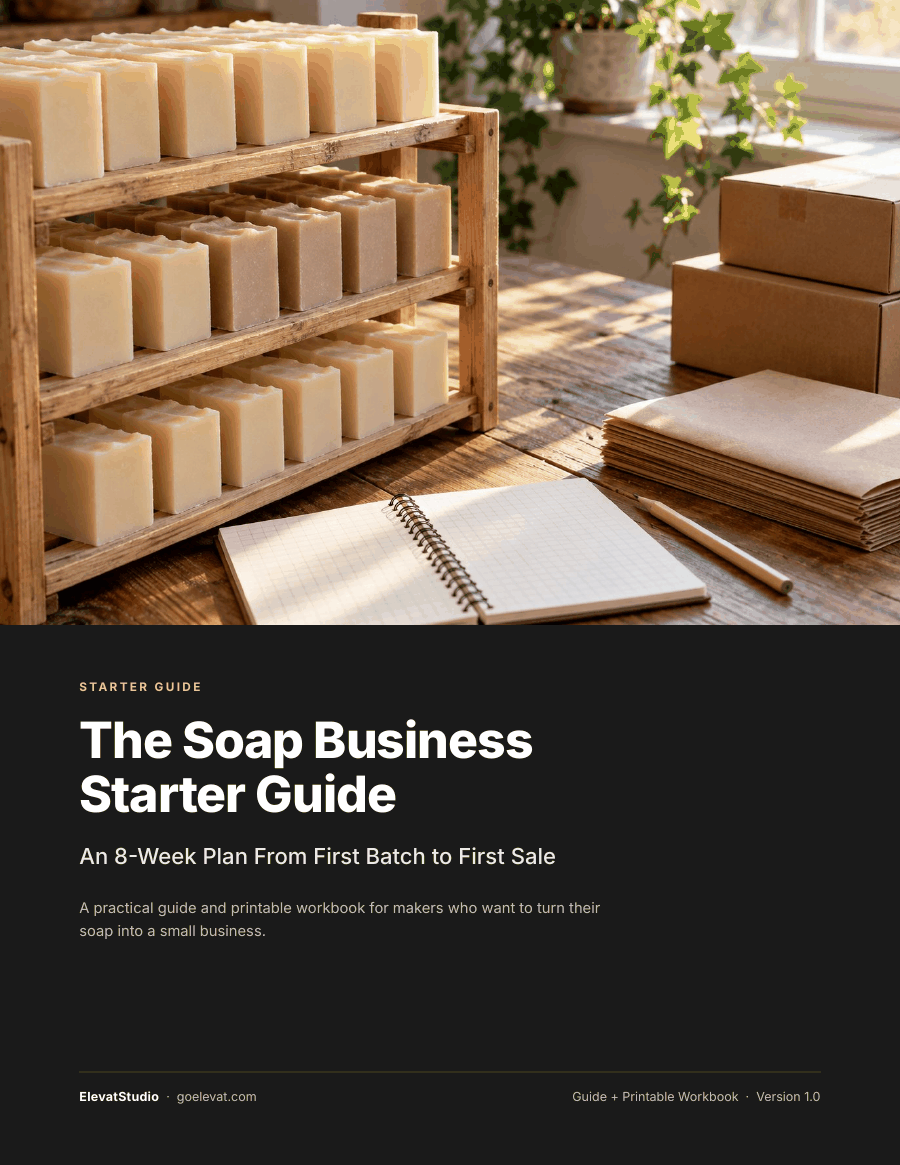
Free guide + printable workbook
The Soap Business Starter Guide
Turn this guide into action, from your first batch to your first sale. Inside the 37-page PDF:
- An 8-week action plan built around real cure times
- 11 practical steps with clear checklists
- 11 fillable, printable worksheets, from a batch and cure log to a cost-per-bar sheet
Free. We’ll also send you practical tips for makers now and then. Unsubscribe anytime.
Frequently asked questions
Can I make and sell soap from home?
In most places, yes. Check your state, city and county rules for business licenses, home-based businesses and zoning, along with your sales tax obligations, before your first sale, because working from home doesn’t exempt you from them.
Do I need a license to sell soap?
There’s no single federal license for selling soap, but your state, city or county may require a business license, a home occupation permit or a sales tax registration. If your product is a cosmetic, the FDA’s rules for cosmetics apply as well, so read step 7 and check with your local offices before you sell.
Do I need insurance to sell handmade soap?
It isn’t always required by law, but it’s strongly recommended, since soap goes on customers’ skin. Craft fairs and local shops may also ask for a certificate of insurance before they work with you.
Does handmade soap need FDA approval?
No. True soap is regulated by the CPSC rather than the FDA, and the FDA doesn’t approve cosmetics before they go on sale, except for color additives. If your soap is a cosmetic, you’re still responsible for its safety and its label, and if you make drug claims, much stricter rules apply.
How long before I can sell my first bar of soap?
With cold process, plan on at least six to eight weeks. Each batch needs about four to six weeks to cure, plus time to use-test the bars, and a recipe change starts that clock again. Melt and pour can be ready much sooner, since it doesn’t need a cure.
Is soap making profitable?
It can be, as long as your price covers the full cost of each sellable bar, including your time, packaging and fees. A low price per bar leaves little room for error, which is why working out your cost in step 5 comes before setting the price.
Can I sell melt and pour soap?
Yes, many makers do. Check the ingredient list of your base, though, since some bases contain synthetic detergents or other ingredients that make the finished product a cosmetic, and label it to match.
Can I start a soap and candle business together?
You can, and plenty of makers sell both. Each product has its own testing, labeling and insurance questions, so it usually works best to launch one line, get it running and then add the other. If candles are part of your plan, our guide to starting a candle business covers that side step by step.
Starting a soap business comes down to a series of careful steps: testing until your bars are consistent, deciding what kind of product you sell, labeling it correctly, pricing from real costs and choosing where to sell first. Take them one at a time, and use the free Soap Business Starter Guide to work through each one with its 8-week plan and fillable worksheets.